Teen Pregnancy Rates in Chicago Over the Past Decade

By: Noelle Sanzeri and Gianni Hrobowski

UIC student Mary Ellen Kandu was faced with some difficult decisions when she became pregnant in 2017. At 18 years-old, she wasn’t sure she was prepared for what lay ahead.

“Being a teen mom wasn’t something I was ready to do and I didn’t have the resources to support me or my child,” she said. “I knew I had options but I felt very alone in the process.”

Kandu is just one of the many teen moms in Chicago who had to make a tough choice for herself and her future child. Would she raise him alone and forgo her plans for college? Would she get an abortion and deal with the backlash from her family? Or would she opt for adoption and the difficult process of finding the perfect family for her child?

Ultimately, she found a family that was the ideal match for her and her son, but not every teen mom is this fortunate. “It was a lengthy process that involved interviewing several families,” she explained, “I wasn’t even sure if adoption was what I wanted to do, I waited two weeks before officially signing any papers,”. Some young moms might feel scared to start this process alone, or might not even know exactly what their options are. 

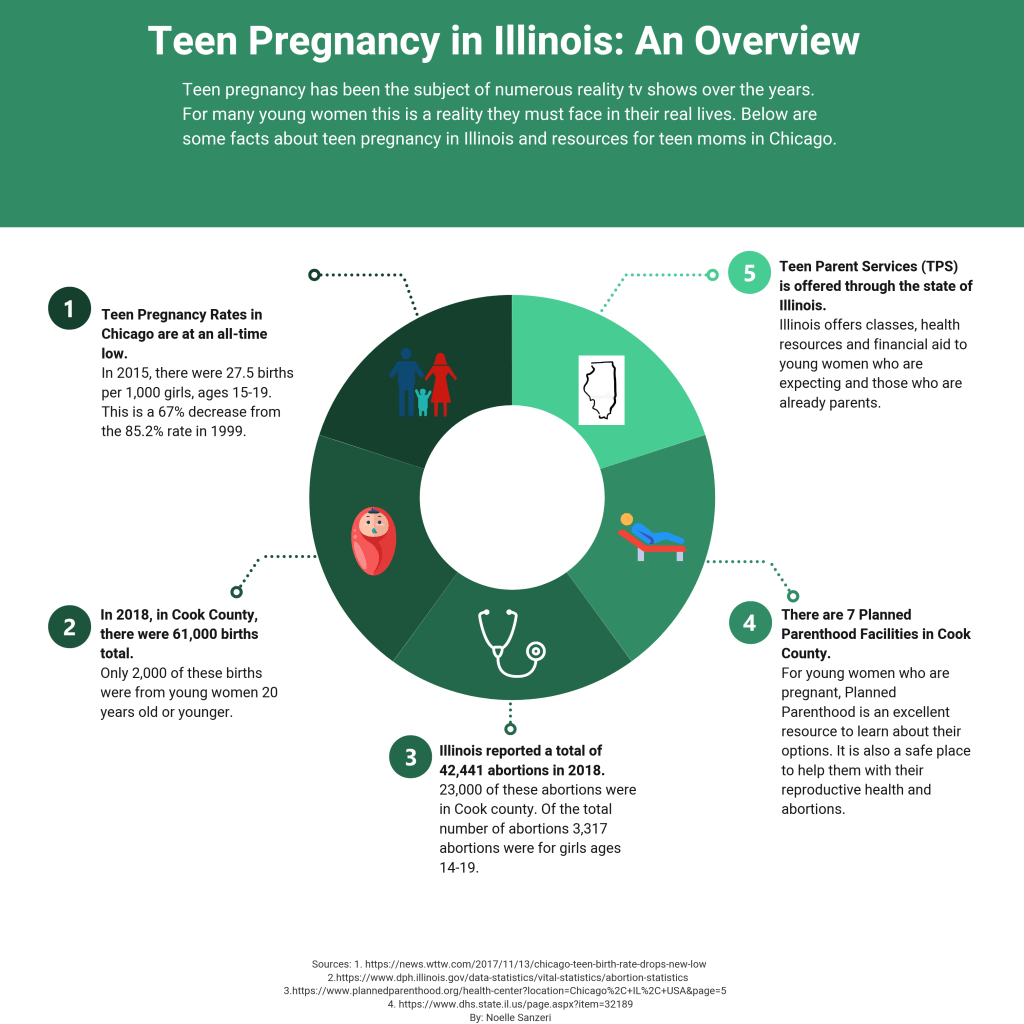
But Mary Ellen’s story is becoming less common, as a 2017 report from the Chicago Department of Public Health says that teen birth rates reached a historic low in the city of dropping from 72 births per 1,000 women to just 41.

According to the study, the low came after eight consecutive years of decline and in 2014, which at the time the most recent piece of data showed that there were 32 births per 1,000 females ages 15-19 years old.  This was more than a 62 percent drop from the 85.2 rate in 1999. 

According to Gutt Matcher Institute, “Abortions in Illinois represent 4.9% of all abortions in the U.S.”. Illinois has also seen an increase in clinics that perform abortions, increasing 4% from 2014 to 2017. This is one of the numerous factors in the drop of teen birth rates in Illinois.

Chicago still has a teen birth rate higher than the national average of 18.8 births per 1,000 women ages 15 to 19 years old, but has dropped more than 20 percent compared to the national rate. The city is taking important steps and going in a direction where we see fewer birth rates occurring. They have seen declines in teen births through all racial and ethnic groups since 2010. African American women are seeing the most drastic decline during that time, dropping from 72 births per 1,000 females to just 41. 

Becoming pregnant as a teen can lead to many challenges for the parents and the child. Studies have also shown that approximately 38 percent of teen mothers earn a high school diploma and less than 2 percent earn a college degree by the age of 30.

When you are faced with challenges of being a teen mother and have to raise a child you have to prioritize your time to take care of another person and not just yourself. Overall, the rates are going down on teen pregnancy in Chicago and more teens are practicing safe sex. 

Mary Ellen also works as an online mentor to teen moms, offering support and talking through issues. “People in this area often don’t feel supported by their families and don’t know what resources are available to them, making an already stressful situation even worse,” she said. 

Susan Altfeld who works at the School of Public Health at The University of Illinois at Chicago said cultures vary as to values around early parenthood and single parenthood and these factors impact rates of teen childbearing. 

Altfeld also cited an article from the CDC that said U.S. teen birth rates decreased 7% from 20.3 births per 1,000 women in 2016 to 18.8 births per 1,000 women in 2017. She added that these statistics aren’t necessarily representative of differing socioeconomic factors or race disparities. 

Altfeld shared an article from the Chicago Public Schools that said schools “must teach sexual health education every year and every school must have two trained instructors who have completed the district’s instructor training.”

Altfeld said CPS districts take learning about sexual health education very seriously and make sure that the curriculum is medically accurate, age appropriate, and comprehensive for students. However, according to ChalkBeat, “150 schools in Illinois, including 22 schools in Chicago, used a sex education curriculum that focused on abstinence as birth control,” as of 2019. 

Although abstinence based sex education can be a cause for concern, CPS schools have strict requirements on what must be taught in schools. From Kindergarten to senior year, students are taught about sexual health at age appropriate levels, according to CPS.
UIC student Noelle Sanzeri’s mother and former teen mom, Leah Kiefer explains, ”There are no easy options. When I was 19 and deciding whether or not I should keep my baby I was pregnant with, so many factors came into play,”. She explains that ultimately even though she didn’t keep the baby she was lucky enough to have options available to her and a supportive family.

Leah Kiefer says, “I wasn’t alone, and that is why it is so important for young moms to know what options are available to them, so that they can create a network of support,”.

Coronavirus Tips and Tricks

The coronavirus is cause a panic across the globe. In the U.S. specifically, the virus has spread like wildfire. Everything is being shut down including schools and restaurants.

Go to any grocery store and all the toilet paper and paper towels are gone. All flu medicine is gone. Streets are empty as almost all jobs transition to at home work for the next month to slow down the spread of the virus.

Amid all the panic it is helpful to know ways to prevent the spread of this pandemic. Below is an infographic with information from the CDC and WHO on ways to protect yourself and others during this time:

Food Deserts are Disproportionately on Chicago’s South Side

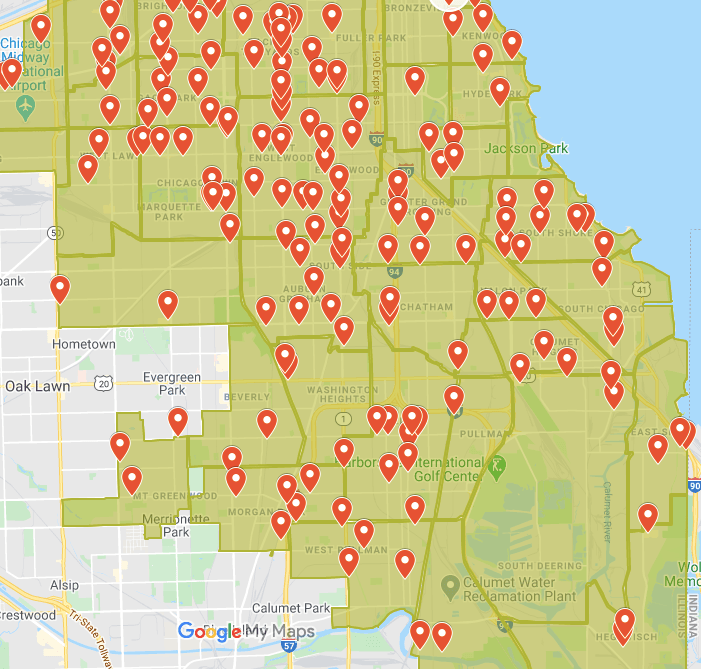
While it is no secret that Chicago suffers from food deserts, most people do not know exactly where they are. Data from the City of Chicago Data Portal shows that the South Side is suffering the most from these food deserts. Below is a map of with pinpoints showing different grocery store locations:

Neighborhoods such as South Deering, only have a total of four grocery stores for the 15,000 people that populate the area. The Mount Greenwood neighborhood only has 2 grocery stores total.

These food deserts are affecting the lives of thousands of people all over Chicago, but especially in the South Side. Residents in these areas are being denied access to healthy, affordable food, and food in general.

Super Tuesday Analysis: Joe Biden and Bernie Sander Neck and Neck in Interest, Warren Trailing Behind Sanders

On: March 4th, 2020 / By: Noelle Sanzeri

Bernie Holds onto Public Interest After Super Tuesday Upset

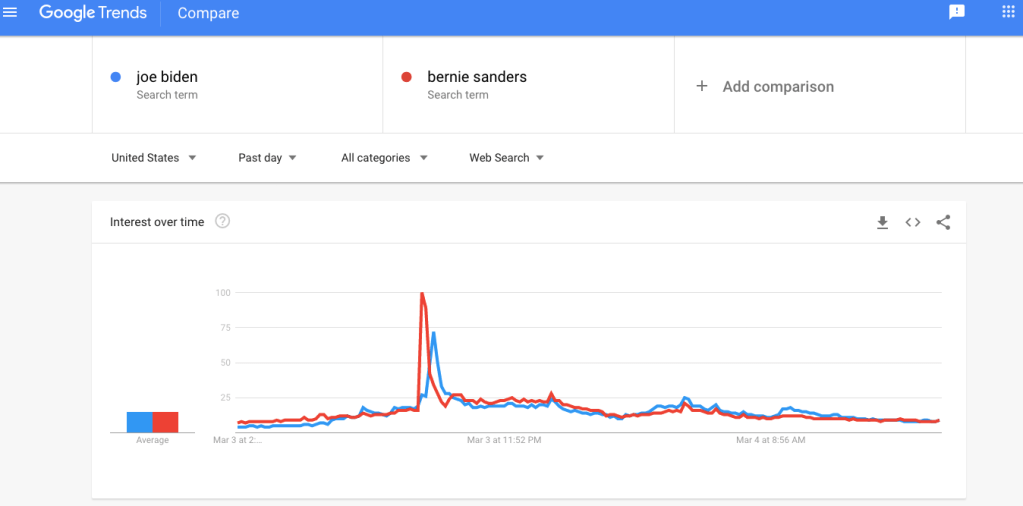
March 3rd, 2020, was a key date in American politics yesterday. It was “Super Tuesday” and people across fourteen different states voted in the Democratic Primaries. So far, the front runner across the board has been Vermont Senator, Bernie Sanders. However, former Obama VP, Joe Biden, has been running in an extremely close 2nd place. This Super Tuesday proved to be an upset for Sanders though, with Biden winning 10 states and Bernie only winning 4 states. Does this mean it’s over for Bernie? Not necessarily according to an analysis of Google search data:

As seen above, Sanders is actually ahead in popular searches the past day during and after Super Tuesday. While this isn’t an indication that Bernie will end with the most delegates, there is still time for him to gain even more momentum over Biden.

Elizabeth Warren Losing Momentum to Biden and Sanders

While this Super Tuesday was an upset for Sanders, it doesn’t seem that the fight is over for him yet. For Elizabeth Warren, however, the race for the Democratic nomination may be over. Warren won 50 delegates total this Super Tuesday trailing behind Bernie’s 388 delegates and Biden’s 433.

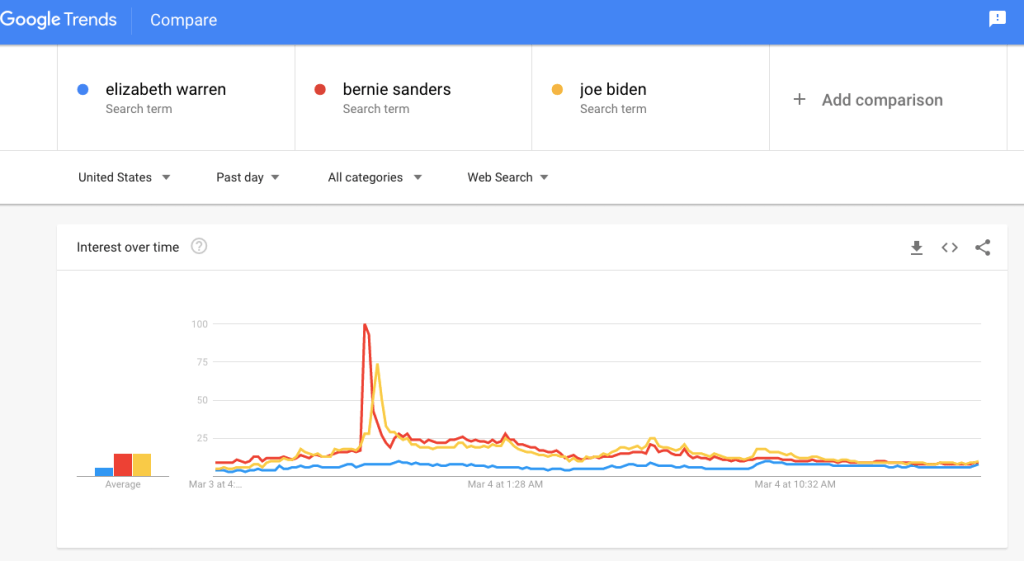
Warren has not dropped out of the race yet though, and it is unclear what her plan moving forward will be. She has no public events until March 6th, where she will either continue with her campaign or officially withdraw. It may be best for to leave now, according to an analysis of Google search data:

Elizabeth Warren in blue, Bernie Sanders in red, and Joe Biden in yellow.

It is clear Warren is behind not only in the polls, but also even in trending searches. Even when Sanders and Biden were surging in searches, she was still practically flatlining, showing a general lack of interest or disengagement with her campaign and policies.

What is the NFL’S Salary Cap?

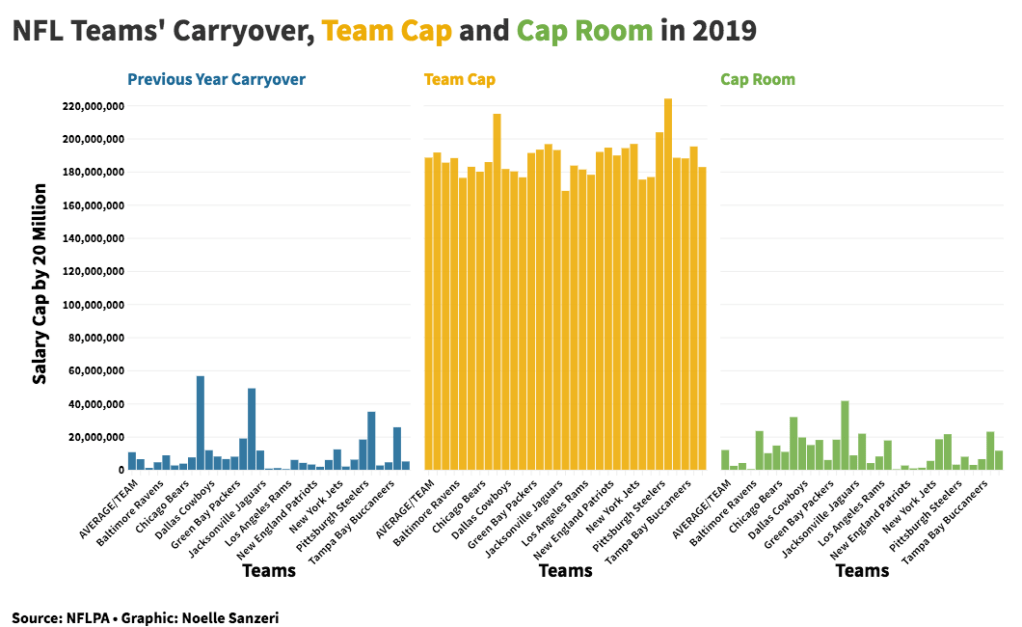
In all professional sports there is a salary cap. This is the amount of money teams are allotted to pay the players on the team. In 2019, the NFL raised the salary cap to $188.2 million, a 6.2% increase from 2018’s $177.2 million cap. Below is a chart comparing NFL team’s salary caps, as well as their carryover not spent from the previous year and cap room:

In the live chart, there is also the number of current contracts each team has. This means the Chicago Bears have 60 players to pay, in addition to having to guarantee a minimum salary to players for credited seasons. A player with 0 credited seasons minimum pay is $495,000. Ten or more credited seasons and the minimum pay surges to $1.3 million.

With players like Russell Wilson, coming in at #1 highest paid player in the NFL in 2019 making $79 million, and other members of the Seattle Seahawks making well over $1 million each year, how do the teams manage to pay their players more than the NFL’s cap? The answer is the team cap. Team cap is calculated by adding the salary cap to the carryover from the year before.

Russell Wilson #3 on the Seattle Seahawks and #1 paid in the NFL in 2019

It is important to note dead money as well when looking at the NFL’s salary caps. This is money the team has already committed to paying or has paid in salaries, but is not charged against the salary cap. However, this amount will need to paid back or taken from the cap at some point. This brings in a key date in the NFL, June 1st. Teams can release high priced players, that might not have performed well and still comply with the cap rules.

Over the last six years, the NFL has continued to raise its salary cap due to revenue growth. In 2018, it was estimated that the total revenue was $15 billion. Even through continued controversies over the National Anthem, and viewership being down, the NFL is a money making machine, making sure players are being well compensated for their performance on the field.

Chicago Pride Parade Attendance Rises Sharply

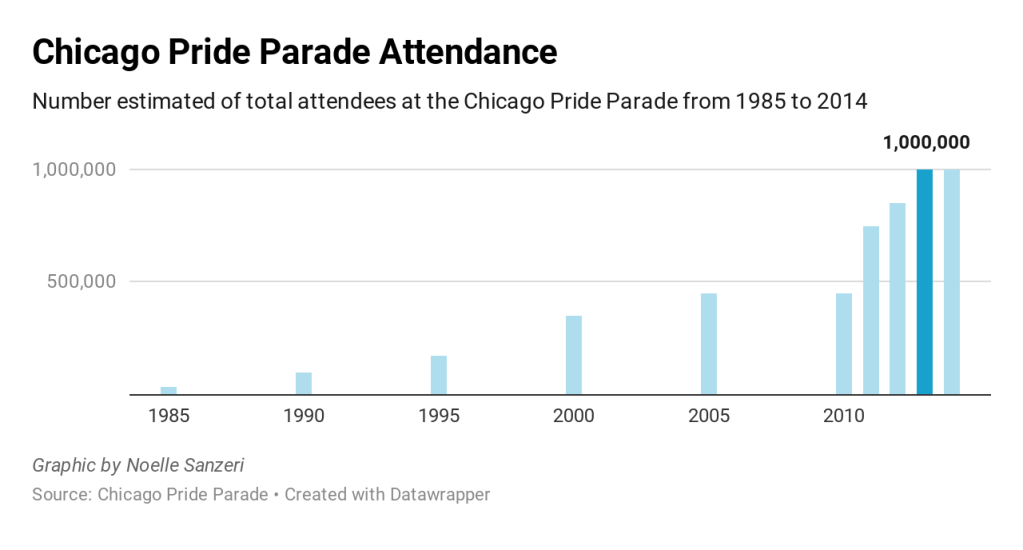
In 2013, the Chicago Pride Parade saw its highest turnout ever, with an estimated 1,000,000 people in attendance. This is a significant increase from previous years with only 450,000 people attending in 2005.

The first “pride parade” in Chicago was in 1970. During that time it was a march of political defiance after the Stonewall Riots in 1969. The riots were acts of resistance against police who would arrest LGBTQ people and raid their bars. The next year the “Christopher Street Liberation Day March” was held in New York and other cities such as Chicago and Los Angeles to continue the political movement to fight for the rights of the LGBTQ community.

Since the parade’s origins, it has grown to become a loud and proud celebration of the LGBTQ community. It is no longer a march to fight for rights, but a political statement and celebration to commemorate how far the community, and America, have come. The turnout for Chicago’s pride has steadily increased over the years, but saw the highest numbers in 2013 when former Governor Pat Quinn signed the “ACT” into effect, legalizing gay marriage in Illinois.

Chicago’s Pride Parade is held in the Boystown neighborhood, the last weekend of June, and is the grand finale of a month of celebrations for LGBTQ Pride month.

Quinn: Pension Reform Harming MAP Grant Program

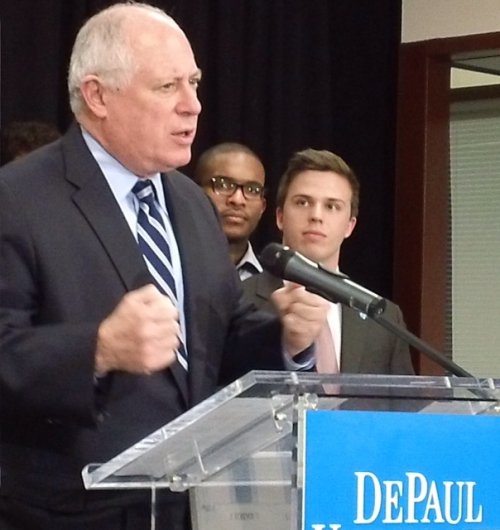
Gov. Pat Quinn talks about MAP grants at DePaul University. (Photo/Bob Smith)

Editor’s note: This story was originally posted on Dec. 12, 2012 and is housed at RedLineProject.org
By Bob Smith

Gov. Pat Quinn visited DePaul University’s Loop campus on Wednesday to discuss how pension reform is harming the Monetary Award Program (MAP) college scholarships and access to higher education in Illinois.

“This is so important to our state, not only in the past, but certainly now and in the future,” Quinn said.
“We want everyone to have the opportunity to go to college that has the ability to go to college.”

MAP grants are need-based college scholarships that allow merit students who are in need across the state and do not need to be repaid by the student. Quinn said that due to cutbacks and having to pay more money in the pension amount, almost 18,000 students lost their MAP grant scholarships this year.


“We do not want anyone denied that opportunity because of finances,” Quinn said. “We can’t afford to lose all the talent that exists, all the ability that exists for higher education to help our economy and to help all of us, because there are financial challenges that deny someone the opportunity to go to community college or a four-year university — public and private — in our state.”

“Every year over 5,000 DePaul students receive MAP grants, and just like the students who have already spoken here today, all of these DePaul students rely on this funding in order to continue their college careers,” Clemmons said.

“Because the number of Illinois students eligible to receive MAP is currently increasing, existing funding does not allow the state to assist all the eligible students. As a result, without action by the Illinois state leadership, more DePaul students than ever will see their MAP funding disappear this year and more DePaul students than ever will be forced to give up their education due to finances.”

More than 150,000 students nationally receive MAP grants each year.

Clemmons told the audience that on Tuesday, DePaul’s SGA unanimously passed a resolution calling on the Illinois general assembly and the governor to ensure the longevity of the MAP program.  He read the resolution aloud and presented a copy to Quinn. 

Ken Thomas, a University of Illinois Board of Trustees student member, MAP recipient and University of Illinois Chicago student, told how he wouldn’t be where he is today if it wasn’t for the MAP grant.

“My mom, when I was in high school, had to work two jobs just to keep food on the table,” Thomas said, “and if we didn’t have [the] MAP program like we do today, I know that I wouldn’t be where I am today; graduating with a degree, hoping to be a productive member of society.” 

Having a productive and functioning society and economy is what Quinn says it’s all about.

“Jobs follow brainpower,” he said. “We want to make sure we have smart people in Illinois. Well skilled, well-educated students coming out of college with graduate degrees and diplomas so they can create jobs, create new businesses,” he said. “Our goal in Illinois is to have at least 60 percent of the adults in our state with a college degree or college associate degree or career certificate by the year 2025. In order to achieve we have to make sure we have a good scholarship program.”

Clemmons said that in order for that to happen, state legislatures need to reflect upon the question, “What must be done?” and do what’s required. 

Design a site like this with WordPress.com
Get started